4.8 / 5
Customer
Satisfaction






A fire hose is a critical tool in emergency response, reliably delivering pressurized water when and where it’s needed urgently. At QRFS, our fire hose options are engineered for durability, flexibility, and dependable water flow rate in demanding environments. These hoses are designed to meet NFPA standards and are trusted by firefighters nationwide.
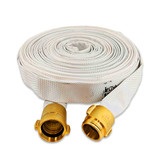
Each firehose features high-quality coupling options, including NST/NH and IPT/NPSH, to ensure secure discharge connections. Whether the hose is used for municipal firefighting, training, or facility protection, our selection supports the high PSI ratings and dependable control required. We also offer a variety of lengths, allowing you to order exactly what your operations and setup need.
You can also explore compatible accessories like fire hose nozzles and hose adapters and reducers to build a complete emergency water supply solution.
Choosing the correct fire hose sizes is essential for meeting the needs of different firefighting applications. QRFS stocks fire hoses in different diameters and lengths to support varying operational and water-flow requirements, from attack lines to large-diameter hose used in high-volume operations.
Standard options include 1-1/2 in., 1-3/4 in., and 2-1/2 in. diameter configurations with standard lengths such as 50, 75, and 100 feet available. Each hose is tested to withstand operational PSI demands while maintaining flexible handling for firefighters in active response scenarios. Understanding water pressure, hose diameter, and coupling compatibility will ensure performance when connecting to a hydrant, standpipe system, or other water source.
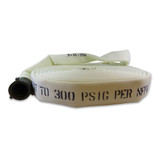
Single-jacket fire hose is a lightweight and flexible option that’s ideal for lighter-duty fire department use, while rack-and-reel hoses are lined for indoor use and storage in pin racks and hose reels, usually as part of certain standpipe systems. Both hose types are designed for easy handling while still delivering dependable water pressure for initial response and suppression.
Single-jacket hoses, which have a polyester single jacket with a single-ply extruded synthetic rubber lining, are commonly used where space and maneuverability are a priority. Rack-and-reel hoses have a polyester single jacket with a synthetic polyurethane/thermoplastic lining. Both offer solid performance for moderate PSI requirements and pair well with standard nozzles and discharge fittings. If portability and ease of storage are priorities, they are an excellent solution.
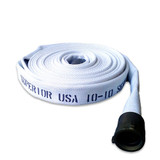
For heavy-duty performance, double-jacket fire hose provides superior abrasion resistance, higher pressure ratings, and a longer service life. These hoses are designed for demanding fire department operations and industrial applications where durability, flow, and reliability are critical.
Double-jacket construction supports higher PSI and sustained water pressure, making it ideal for exterior hydrant connections and high-flow water lines. With reinforced jackets and secure couplings, these hoses perform under extreme conditions while maintaining flexibility during deployment.
Various models are UL-Listed, FM-Approved, and otherwise NFPA-compliant. QRFS also offers bulk discount orders and fast shipping, making it easy to outfit your team with priority-ready equipment.
For additional firefighting items, explore our full selection of Fire Hose & Hydrants equipment, or return to the QRFS home page to shop all fire protection solutions.
What’s the difference between an attack hose and a supply hose?
Attack hose is designed for direct firefighting and handling high water pressure during fire suppression, providing flexibility and durability to maneuver around obstacles. Supply hose, on the other hand, transports large volumes of water from a hydrant or pump to the fire engine. The two are constructed differently to suit their specific roles.
How do I choose the right size of fire hose?
Choosing the right hose size depends on the desired water flow, pressure, and ease of handling for the application. Smaller diameters, like 1-1/2 in., are easier to maneuver and good for tight spaces, while larger diameters, like 2 in. and above, provide higher flow rates. You should balance weight, flow (GPM), and your team's physical capability when selecting hose size.
What are the advantages of a double-jacket fire hose?
Double-jacket hoses have two woven layers around the liner, offering enhanced abrasion resistance and greater pressure tolerance than single-jacket hoses. This makes them ideal for demanding firefighting operations and prolonged use under stress. They also tend to have a longer service life in heavy-duty environments.
When should I consider a single-jacket fire hose?
Single-jacket fire hoses are lighter and more flexible, making them suitable for light-duty, periodic, or rural applications, such as wildland firefighting, where mobility is key. They typically handle moderate pressures and are easier to store and deploy, making them ideal for scenarios where quick deployment is critical but abrasion resistance—where double-jacket hoses are the better option—is less vital.
What maintenance practices help extend the life of a fire hose?
Proper maintenance includes cleaning off dirt and debris after use, draining and drying the hose thoroughly before storage, and inspecting for wear or damage. Storing hoses in a well-ventilated, shaded area and avoiding dragging them over rough surfaces also helps preserve their service life. Cleaning removes dirt, chemicals, and contaminants that can degrade the jacket and liner material over time. Regular cleaning, followed by thorough drying, mitigates mildew and prolongs a hose's usable life.
How often should a fire hose be tested and inspected?
Fire hoses should undergo regular visual inspections and service testing in accordance with NFPA standards, typically at least annually, or more frequently if heavily used. During testing, hoses are pressurized to their service test pressure and checked for leaks and coupling integrity.
Can different hose diameters affect firefighting performance?
Yes, larger-diameter hoses generally move more water (higher GPM), but they weigh more and are harder to handle. Smaller diameter hoses are easier to maneuver but deliver lower flow, so choosing the right diameter depends on whether volume or mobility is the priority.
What should I inspect on my fire hose before putting it into storage?
Before storage, inspect the hose jacket for cuts, abrasions, or soft spots, and check couplings for secure attachment and thread damage. Make sure the hose is completely dry and that any defective sections are tagged and removed from service.