4.8 / 5
Customer
Satisfaction







A fire sprinkler shut-off tool is essential for quickly stopping an activated sprinkler head and protecting your building from unnecessary water damage. When a fire sprinkler releases water for a non-fire cause — such as an accidental impact, random heat exposure, or equipment failure — these compact tools help onsite staff, firefighters, and others stop an activated sprinkler within seconds. QRFS carries the industry’s top options — Shutgun and Quickstop tools — to help you prevent excessive water damage, protect property, and resume normal operations fast.
These devices are designed for building owners, facility managers, construction and remodeling contractors, and emergency responders who need a reliable fire sprinkler head shut-off tool on hand during maintenance, inspections, renovations, or emergency situations. By giving you a fast way to stop an activated fire sprinkler, they can minimize disruption and avoid major cleanup costs.
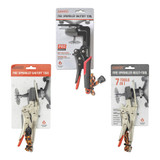
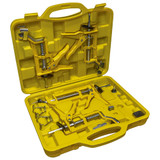
Both the Shutgun and Quickstop are portable tools that clamp onto a sprinkler head to shut off the activated water flow. They work by sealing the orifice where water is released, and both also serve as temporary sprinklers that can keep a system working — and a building open — until replacement sprinklers are installed. These tools work with most sprinkler types commonly found in commercial buildings, industrial facilities, hotels, homes, and high-rises. However, there are some differences between the products:
To learn more about the differences between these two sprinkler stoppers, read this blog.
Both of these tools are invaluable in cases of an accidental sprinkler activation, which may occur when vandals, workers, or passersby impact a fire sprinkler head. A shutoff tool can stop the water way faster than waiting for a fire department response or finding the control valve and manually shutting down the entire system or a portion of it.
Using a fire sprinkler stopper can prevent water damage, safeguard equipment, and maintain building operations—especially when every second counts. These tools, often kept in a fire extinguisher cabinet on every floor in large buildings, give maintenance personnel and fire protection pros a reliable way to protect property by limiting unnecessary water release.
QRFS offers a wide selection of fire protection parts to help you safeguard your building, including our full line of shutoff tools. We ship fast and provide unparalleled customer support. Need additional fire protection equipment? Check out:
Or return to the QRFS homepage to see our full inventory!
1. What is a fire sprinkler shut-off tool, and why might I need one?
A fire sprinkler shut-off tool, whether the Shutgun or Quickstop, is a portable device designed to seal the outlet on an activated sprinkler head, stopping unwanted water discharge quickly. They’re useful for preventing extensive water damage when a sprinkler head activates improperly (e.g., due to an accidental bump, vandalism, a flying ball, or construction). These sprinkler stoppers can halt the flow much faster than finding the system’s control valve and shutting it off — especially since many control valves are purposefully locked in the open position.
2. How fast can a sprinkler shut-off tool stop water from an activated head?
With the right tool (properly used), water flow from an activated sprinkler head can usually be stopped within seconds. The trigger-action designs of both the Shutgun (similar to a caulk gun) and Quickstop (similar to a wrench or pliers) allow for quick, one-handed operation.
3. What types of sprinkler heads can the Shutgun handle?
Shutgun offers a range of models tailored to different sprinkler head scenarios. Its standard model works on common pendent, upright, and sidewall heads with standard orifices. For other types — sheared-off heads, concealed heads, and institutional heads — there are specialized Shutgun variants. A full Shutgun kit has every model and attachment to handle all of these scenarios and sprinkler types in 1/2 in. and 3/4 in. sizes.
4. Why might using a shut-off tool be preferable to shutting off the sprinkler system via a control valve?
Using a shut-off tool seals only the activated sprinkler head, stopping water flow immediately without disabling the entire sprinkler system or a significant portion of it. Closing control valves, by contrast, may shut down all downstream sprinklers and impair the system, leaving the building at risk if a real fire occurs. Also, control valves are often hard to access and locked in the open position to help ensure that the system will activate in an emergency — so, it may take some time to close it.
5. Does a shut-off tool like Shutgun or Quickstop act as a permanent replacement for a sprinkler head?
No — these tools are temporary solutions. Each device’s built-in heat-sensitive fusible link allows it to serve as a temporary sprinkler if a real fire occurs while the tool is still installed. However, system owners should still replace the activated sprinkler as soon as possible.
6. Are tools like Quickstop and Shutgun equally suitable for all building types?
It depends on the sprinkler system and the types of heads within it. Quickstop tools offer an “all-in-one” convenience for many applications, handling most exposed pendent, sidewall, and upright sprinklers. For buildings and systems with a wider variety of sprinkler head types or those featuring specialized heads, Shutgun’s range of models offers more options. Read this blog to learn more about the differences.
7. Who should consider keeping a sprinkler shut-off tool on hand?
Property owners, facility managers, contractors, maintenance personnel, or anyone who works in buildings with sprinkler systems — particularly in commercial, residential, or mixed-use settings. This usefulness increases in high-traffic occupancies — such as hotels — that are prone to accidental activations. Shut-off tools are also valuable for crews doing renovations, maintenance, or moving work, where accidental sprinkler hits are more likely to occur.