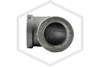









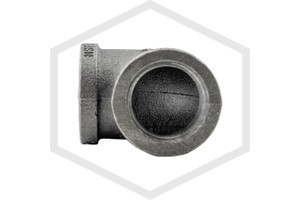



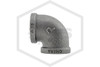

Ductile Iron Fitting |3/4 in. 90 Degree Elbow
This ductile iron fitting, commonly used in fire protection and plumbing systems, provides a durable connection between pipe segments. These fittings are available in various configurations such as {examples: elbows, tees, reducers, crosses, caps, flanges, and unions}, allowing designers and contractors to build complex, pressure-rated systems with reliable performance. Ductile iron's mechanical strength and dimensional consistency make it a trusted choice in critical infrastructure.
Will this item fit my fire sprinkler or plumbing system?
This ductile iron 90 Degree Elbow is designed for use with pipe systems that require threaded ends. It connects to pipe of matching size and configuration. In fire sprinkler installations, these fittings are often used to route water through risers, mains, or branches. They are compatible with standard pipe specifications, ensuring a tight and leak-resistant fit when properly installed. Grooved fittings work with mechanical couplings to simplify installation and allow limited flexibility, while threaded fittings are often used for smaller systems or where disassembly is required.
Installers should confirm the compatibility of fitting ends with the corresponding pipe or equipment. When used in assemblies with valves, gauges, or drains, ductile iron fittings help maintain alignment and flow integrity. Their standard sizing and connection types make them interchangeable with other fittings manufactured to NFPA or ASTM specifications.
Is ductile iron a good material for fire sprinkler piping?
Ductile iron is widely used in fire protection systems due to its strength, ductility, and resistance to mechanical failure. Unlike gray cast iron, ductile iron can withstand high internal pressure and absorb shock without cracking. These properties are especially important in systems exposed to pressure changes, thermal expansion, or mechanical stress. The material's ability to flex slightly under load gives it a distinct advantage in demanding environments.
Most ductile iron fittings used in fire systems are coated or painted to resist corrosion, extending service life even in wet or corrosive conditions. However, in dry-pipe systems, where condensation and air can accelerate corrosion, additional measures such as nitrogen purging or internal linings may be recommended. Ductile iron fittings should not be mixed with incompatible materials like galvanized steel unless dielectric fittings are used to mitigate galvanic corrosion.
Contractors working with ductile iron fittings should plan for proper support and handling, as ductile iron is heavier than some alternative materials. Despite this, its mechanical properties and resistance to deformation under load make it a dependable choice for fire protection and other pressurized water systems.